

Views: 0 Author: Site Editor Publish Time: 2026-10-07 Origin: Site
You are in the 85th minute of a crucial match. Sweat is pouring. Suddenly, a sharp, burning sensation on your heel ruins your sprint. Your sock bunched up inside your boot. Flashy cleats always get the glory on the pitch. Yet, high-quality internal gear is the actual foundation of on-field performance and long-term foot health.
As a sports textile engineer, I constantly see players spend hundreds on premium boots, only to ruin their biomechanics with cheap, poorly constructed tubular fabrics. Quality apparel does much more than just cover your skin. It actively prevents friction injuries, anchors your protective gear, and optimizes energy transfer. Proper biomechanical support reduces fascia strain significantly. This allows you to maintain peak agility from kickoff to the final whistle. Here, we break down exactly how to evaluate durable athletic gear, focusing strictly on the non-negotiable technical features of arch support and targeted cushioning.
Durability is driven by material engineering: Synthetic blends combined with combed cotton prevent blowouts and ensure season-long longevity.
Arch support prevents fatigue: A snug elastic band woven around the midfoot reduces plantar fascia strain during grueling games.
Cushioned footbeds absorb shock: Dense terry loop padding strategically placed in the heel and toe box protects against the harsh impact of dry grass and artificial turf.
Fit and grip matter: Proper sizing eliminates the micro-movements that cause blisters, while modern anti-slip silicone features keep the foot locked securely into the boot.
Not all gear is equal: Specialized field equipment requires vastly different specifications compared to standard gym wear.
The sports textile sector is experiencing a massive technological shift. Manufacturers are aggressively pivoting away from basic cotton tubular designs. The current professional standard relies on 3D-knitted synthetic blends equipped with targeted compression zones and advanced grip technologies. Recent market data shows a surge in demand for anti-slip PVC or silicone grips bonded to the sole. Athletes now realize that footwear accessories are no longer mere apparel. They are critical, injury-preventing biomechanical equipment. Smart textiles that offer variable density knitting are dominating elite locker rooms, setting a new baseline for amateur and professional gear alike.
In competitive sports, the margin between success and failure is measured in fractions of a second. Discomfort caused by poorly designed footwear directly impacts a player's reaction time. When you experience pinching or excessive pressure inside your cleats, your biomechanics subtly shift to compensate for the pain. This unnatural adjustment reduces agility and decreases overall efficiency on the field. High-quality gear acts as a precision interface between the foot and the shoe. It ensures tactile feedback remains sharp and explosive movements are unhindered.
Blisters are the dreaded result of friction, heat, and moisture. During a 90-minute match, the human foot produces a massive amount of sweat. If this moisture is trapped against the skin, the epidermis softens and tears easily under shear stress. To combat this, professional-grade Soccer Socks utilize advanced moisture-wicking technologies. These fabrics actively pull sweat away from the skin and push it to the outer layer for rapid evaporation. Maintaining a dry microclimate inside the cleat drastically reduces the friction coefficient.
Football requires specialized lower-leg protection due to its highly physical nature. Over-the-calf lengths are strictly non-negotiable. This extended profile securely anchors shin guards in place during aggressive tackles. It also provides a vital layer of defense against turf burns. Furthermore, a well-constructed garment offers localized compression that supports the calf muscles, reducing the micro-vibrations that trigger muscle fatigue.
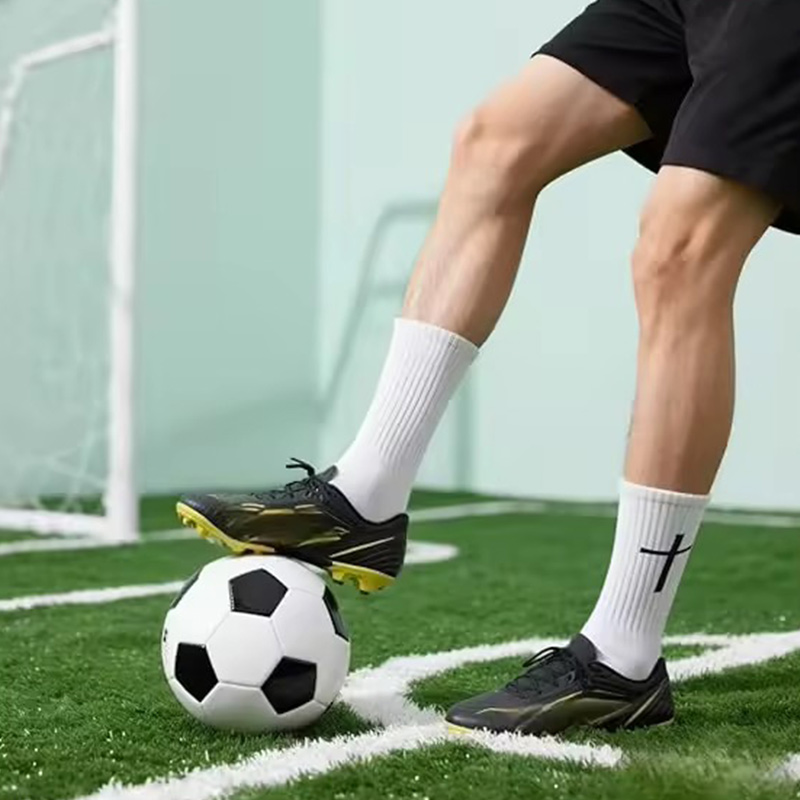
Arch support in athletic hosiery refers to a strategically placed elastic compression zone encircling the midfoot. Unlike rigid plastic orthotic insoles, textile-based arch support relies on circumferential tension. This specialized band gently hugs the navicular bone and surrounding structures. It provides a continuous mild compression that mimics the natural fascia network of the human foot.
Running continuously on uneven grass or rigid artificial turf places immense mechanical stress on the plantar fascia. Without adequate support, this tissue becomes inflamed. The compressive arch band acts as an external ligament. It absorbs a portion of the mechanical load during the foot strike phase, stabilizing the midfoot and delaying the onset of muscular fatigue.
Material displacement is a massive issue with inferior apparel. When you plant your foot to change direction rapidly, loose fabric bunches up under the arch. This creates severe pressure points that compromise your stance. Integrated arch support ensures the fabric remains taut and flush against the skin. This seamless fit maximizes the efficiency of the cleat's design.
Modern football is frequently played on unforgiving surfaces like artificial turf or sun-baked grass. Every time you sprint or land from an aerial duel, your foot absorbs kinetic energy equivalent to several times your body weight. A cushioned footbed features densely woven terry loops under the sole. This extra material volume acts as a mechanical shock absorber. It dissipates impact forces before they travel up the skeletal chain to your knees.
A common misconception is that a thicker sock is universally better. Uniformly bulky garments drastically alter the fit of a precisely sized cleat, restricting blood circulation. Objective performance design dictates the use of targeted cushioning. Extra padding must be strictly isolated to high-impact zones like the heel pad and the toe box. Meanwhile, the instep remains thin and breathable, allowing for a barefoot-like touch on the ball.
| Feature | Standard Gym Sock | Professional Football Sock |
|---|---|---|
| Material Base | 100% Cotton | Polyester / Nylon / Spandex Blend |
| Cushioning | Uniformly thick or entirely flat | Targeted terry loops at heel and toe |
| Arch Support | None | High-tension elastane midfoot band |
| Grip Tech | Slippery fabric surface | Anti-slip PVC/Silicone sole pads |
The foundation of any highly durable athletic garment lies in its yarn composition. Relying on outdated materials guarantees mid-game blowouts and severe blistering.
Nylon is renowned in textile engineering for its exceptional tensile strength and abrasion resistance. It forms the structural skeleton of the garment. Polyester complements this by offering superior hydrophobic properties. Unlike natural fibers, polyester facilitates rapid moisture transfer rather than absorbing sweat into its core. Together, these synthetic workhorses resist tearing from cleats and keep the foot remarkably dry.
Durability is useless if the garment does not conform precisely to your foot's topography. Spandex is an elastic polyurethane fiber capable of stretching massively and returning perfectly to its original shape. Premium gear typically integrates 5 to 10 percent spandex into the fabric. This provides the vital elasticity needed for the arch support band and ensures shape retention after repeated wash cycles.
Modern engineering incorporates external grip technology. High-end models feature heat-bonded silicone or PVC dotted patterns across the sole. These friction pads lock directly into the insole of your cleat. This mechanical lock eliminates internal foot slippage, transferring 100 percent of your kinetic energy into the ground during sharp cuts.
Understanding the specific biomechanical requirements of different athletic activities is crucial for performance optimization. Structural engineering differs significantly based on the intended use.
In the sporting goods industry, these terms are used interchangeably based on regional dialects. Functionally, both refer to the exact same piece of equipment. They feature an over-the-calf length designed to securely hold shin guards while providing abrasion resistance against sliding tackles.
The mechanical stress placed on the foot during a football match is vastly different from a linear distance run. Runners prioritize ultra-lightweight mesh to accommodate repetitive forward-motion strikes. Wearing standard Running Socks on the pitch results in inadequate lower-leg protection and premature wear in the toe box due to aggressive lateral friction.
Standard gym wear lacks the targeted technical features required for elite field performance. Generic Sports Socks usually feature a uniform thickness that causes severe bunching inside a tight cleat. Specialized field equipment utilizes variable density knitting. It stays thin on top for breathability while heavily reinforcing the high-wear zones.
Selecting the optimal gear requires a systematic approach. Follow these objective engineering criteria to ensure maximum comfort and biomechanical support.
A proper fit is your first line of defense against injuries. Excess fabric folds and creates agonizing friction points. Conversely, overly tight garments restrict blood circulation. Measure your foot length and look for a firm, compressive fit around the midfoot arch.
Human feet are asymmetrical. Traditional hosiery is manufactured as a uniform tube, which is structurally flawed. Premium athletic gear is anatomically engineered with specific left and right profiles. This ensures the cushioned footbed aligns precisely with your unique impact zones.
Carefully inspect the top of the instep and the rear calf area for integrated mesh ventilation panels. These zones must utilize a looser knit pattern to facilitate rapid sweat evaporation. Effective thermal regulation prevents the skin from softening.
Internal foot slippage wastes energy and destroys agility. Ensure your selection includes heat-bonded silicone pads on the external sole. This technology creates a unified mechanical system between your foot and the shoe, reducing shear stress on the plantar fascia.
Even the most technologically advanced apparel degrades rapidly under improper laundering techniques. Implementing a strict care regimen preserves elastane integrity and maintains the loft of the cushioned footbed.
Always turn your athletic gear inside out before washing. This exposes the interior terry loops to direct water agitation, flushing out trapped sweat. It also protects the exterior silicone grip pads from abrasive friction. Wash in cold water. Hot water accelerates the breakdown of spandex, leading to a permanent loss of compression. Strictly avoid liquid fabric softeners. They leave a waxy coating on synthetic fibers that completely destroys moisture-wicking capabilities.
Thermal degradation is the primary enemy of athletic textiles. High-heat tumble drying bakes and destroys elastic fibers. The most effective technique is to air-dry the garments flat on a rack, away from direct ultraviolet sunlight. If a machine dryer is absolutely necessary, select a strict air fluff cycle with zero heat.
Choosing the right internal gear is just as vital as finding the perfect pair of cleats. A premium, well-engineered sock is the true foundation of on-field performance. Always prioritize heavy-duty synthetic materials, strong elastic arch support, and targeted cushioning to combat foot fatigue and absorb heavy turf impacts.
Stop letting cheap cotton tubes ruin your agility and destroy your feet. By investing in quality items engineered for the specific biomechanical demands of the sport, you protect your most valuable assets. Upgrade your kit today and experience the undeniable difference that professional-grade gear brings to your game. Ready to outfit yourself or your entire team with elite, anti-slip technology? Explore the customizable, high-performance options at Sock Supply Chain to find the exact specifications you need to dominate the pitch.
They should feature variable, targeted thickness rather than uniform bulk. Optimal designs incorporate a thicker, cushioned footbed specifically at the heel and toe box to provide shock absorption. The top of the foot and calf sections must remain thin and breathable to ensure the foot fits comfortably inside a tightly laced cleat.
It is highly discouraged. Running apparel is cut too low to cover shin guards, which are mandatory for safety. Furthermore, they lack the structural reinforcements in the toe and heel required to withstand the aggressive lateral movements and direct ball-striking impacts inherent to football.
Many professionals cut the foot section off their officially issued team gear. They do this to wear specialized, high-friction silicone grip socks directly against their skin. They then use the remaining calf tube of the official gear to hold their shin guards, connecting the two pieces with cohesive sports tape to comply with uniform regulations.
For active players on the pitch two to three times per week, replacement is required every 6 to 12 months. Objective indicators include visible flattening of the cushioned footbed, a loss of tightness in the arch support band, or the fabric failing to securely hold a shin guard.
Yes. Biomechanical observations prove that the elastic midfoot band provides targeted compression that stabilizes the plantar fascia. This improves local blood circulation, delays foot fatigue, and keeps the fabric locked tightly against the skin to eliminate friction blisters.
Absolutely. Grip socks utilize external silicone or PVC pads that lock into the cleat's insole. By eliminating the micro-sliding between your foot and the boot, you reduce wasted kinetic energy. This translates directly into faster change-of-direction speeds and more explosive sprint take-offs.
Blister prevention requires controlling friction and moisture. First, ensure your cleats are properly sized. Second, wear high-performance synthetic socks with targeted heel cushioning and moisture-wicking properties. Avoid cotton entirely, as wet cotton maximizes friction against the stiff materials of a brand-new boot.


